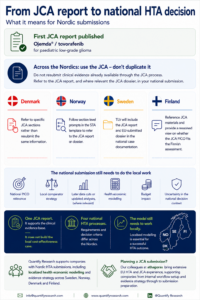
The first Joint Clinical Assessment report under the EU HTA Regulation is now published. It covers Ojemada® / tovorafenib, for paediatric low-grade glioma.
Across the Nordics, the message from national HTA agencies is consistent:
Do not resubmit clinical evidence already available through the JCA process.
Instead, use the JCA report and, where relevant, the JCA dossier as reference points in the national submission.
This is already reflected in national guidance:
📍 Denmark asks applicants to refer to specific JCA sections rather than resubmit the same information.
📍 Norway’s STA template gives section-level prompts for where to refer to the JCA report or dossier.
📍 Sweden’s TLV will include the JCA report and EU-submitted dossier in the national case documentation.
📍 Finland asks applicants to reference JCA materials and explain whether the JCA PICO fits the Finnish assessment.
The national HTA submission still needs to do the local work:
➡️ National PICO relevance
➡️ Local comparator strategy
➡️ Later data cuts or updated analyses
➡️ Health economic modelling
➡️ Budget impact
➡️ Uncertainty in the national decision context
This is especially important for health economics.
A JCA report can support the clinical evidence base. It does not build the local cost-effectiveness case.
Quantify Research supports companies with Nordic HTA submissions, including localized health economic modelling and evidence strategy across Sweden, Norway, Denmark, and Finland.
How are you preparing your Nordic HTA strategy after the first JCA report?
Planning a JCA submission?
Our colleagues at the athagoras Group bring extensive EU HTA and JCA experience, currently supporting multiple ongoing JCAs through evidence generation, dossier development, and submission preparation, helping companies navigate the evolving EU HTA landscape.